



Nov 06, 2026
Overhead Insulated Cable Selection Guide: Types, Sizes, and Standards
Overhead insulated cables may look similar, but they are designed to meet the power transmission requirements of different networks. 600 V or 0.6/1 kV aerial bundled cable (e.g., as part of an overhead service drop) and medium-voltage covered conductor are not interchangeable by definition. Matching construction to the network is just as important for engineers and buyers as conductor size. Here are the key checks to make before you buy.
What Types of Overhead Insulated Cable Are Used in Power Distribution?
Overhead networks use bundled assemblies, individual insulated conductors and weather-resistant covered conductors. Their support arrangements are not interchangeable.Low Voltage Overhead Insulated Cable: ABC and Service Drop Cable
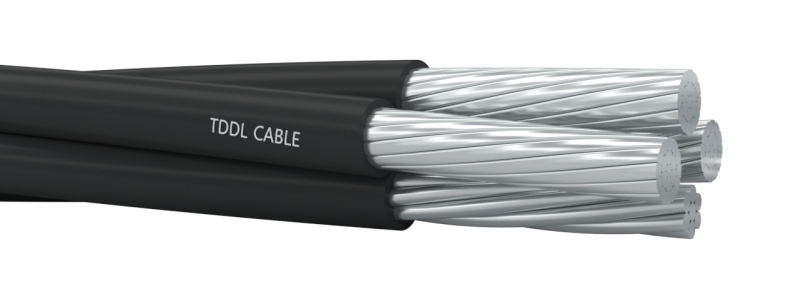
Aerial bundled cable (ABC) is used in overhead-line design for low-voltage distribution. NF C 33-209 covers 0.6/1 kV ABC. Its phase or lighting conductors use AAC with XLPE insulation; the neutral uses AAAC with XLPE insulation. The black XLPE insulation is UV-resistant and rated for a long-term operating temperature of 90 °C.
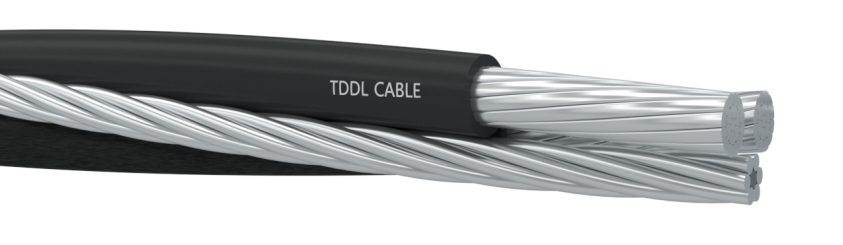
The service drop cable supplies street lighting and temporary construction connections. Neutral-supported assemblies are rated at 600 V phase-to-phase or less as per ANSI/ICEA S-76-474. Phase conductors are usually aluminum, and the neutral — which may be bare or insulated — can be aluminum, aluminum alloy, or ACSR. Before ordering, confirm its support structure.
Medium Voltage Overhead Insulated Cable
Medium-voltage installations follow standards including ANSI/ICEA S-121-733, EN 50397, ABNT NBR 11873. Tree wire and messenger-supported spacer cable carry rated phase-to-phase voltages up to 46 kV. These should be mounted with the help of adequate insulators or spacers depending on their working voltage.For 10 kV aerial distribution, PE- or XLPE-covered conductor constructions are available with aluminum, aluminum-alloy or copper conductors. Select applicable standards and confirm the required support system and covering compatibility during design.
Which Specifications Matter Most When Choosing Overhead Insulated Cable?
Electrical, environmental and mechanical requirements all matter. Nominal conductor size alone cannot capture all of them.Voltage Rating and Applicable Cable Standards
Select the relevant standard before comparing quotes. NF C 33-209 covers LV ABC (0.6/1 kV); ANSI/ICEA S-76-474:2004 covers service drop assemblies at 600 V; GB/T 12527 covers low-voltage aerial insulated cable; and GB/T 14049 covers 10 kV aerial cable. ANSI/ICEA S-121-733 is the standard for tree wire and spacer cable. Some constructions of the cable may also refer to IEC 60502-1 and IEC 60502-2. Do not assume that these standards are the same – get it right for your specific design and testing requirements.Aluminum vs. Aluminum Alloy vs. Copper Conductors
Aluminum provides a low weight and often a lower material cost. Compared to normal AAC, AAAC has higher mechanical strength. Copper offers higher conductivity at the same cross-section, at a higher cost and weight. ACSR (Aluminum Conductor Steel Reinforced) is made of aluminum over a steel core for strength. Compare electrical capacity and mechanical performance, not just price per meter.PE, PVC, and XLPE Insulation Materials
Covering material affects normal operating temperature and outdoor durability. The examples below refer to specific low-voltage constructions, not universal material ratings.| Material | Maximum conductor operating temperature |
| PE | 70 °C / 75 °C |
| PVC | 70 °C |
| XLPE | 90 °C |
How Do You Select the Right Overhead Insulated Cable for a Project?
Start with the network requirements — voltage level, short-circuit characteristics, environmental conditions, and load profile — not with products that merely look equivalent.Calculate Conductor Size Based on Load and Voltage Drop
Start with load current, voltage and route length. Select an initial cross-section, then check ampacity and voltage drop against project limits. Results are affected by conductor resistance, circuit layout, operating temperature and power factor. Important: Two circuits with identical 70 mm² conductor cross sections may produce different voltage-drop results if they differ in route length or applied load. Each circuit must be checked individually — an identical cross section does not mean one calculation covers both. Use consistent units: mm², AWG or kcmil. Confirm whether you follow IEC or NEC standards before selecting reference parameters. Complete the short-circuit thermal-withstand check during design, using the final selected cross-section. If you increase conductor size to satisfy voltage-drop constraints, re-run short-circuit verification.Check Span Length, Mechanical Strength, and Installation Conditions
Review span length, sag-tension limits, wind and ice loading, and clearance distances to ground, buildings and tree vegetation. Ensure all hardware and installation methods are fully compatible with the selected cable. Conductor size alone cannot define maximum safe span length. Final mechanical parameters must be reviewed and approved by line design engineers.Prepare an Overhead Insulated Cable RFQ Checklist
Before requesting quotations, provide enough information to identify the right construction:1. System voltage and required cable standard.
2. Conductor material, structure, cross-section and core configuration.
3. Insulation or covering material, temperature requirement and UV resistance.
4. Neutral or messenger or support hardware details.
5. Span length, sag and tension limits, wind and ice loads, clearance to ground, buildings, and trees, total quantity and delivery destination.
Provide, as required, a parameter table corresponding to the quoted model, as well as a list of routine/sampling test reports and the delivery method.
How Can TD Cable Support Overhead Cable Procurement?
At TD Cable, we produce wire and cable for power distribution, including low- and medium-voltage overhead products. Our range covers aerial bundled cable, service drop cable, tree wire and other covered conductors.Matching Project Requirements to TD Cable Products
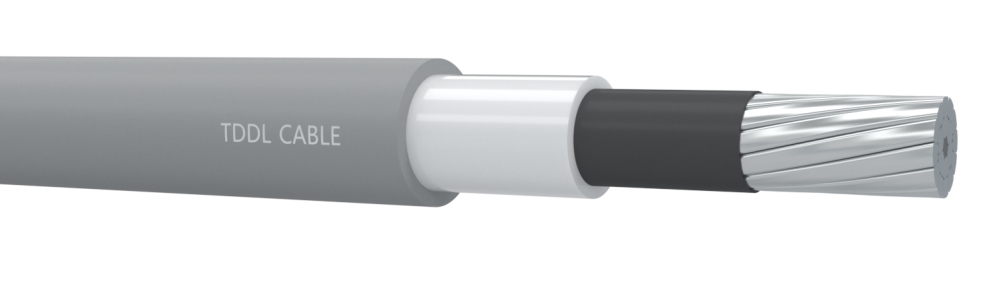
600 V ABC cable, PE or XLPE insulation. For tree wire or spacer-supported cable, the maximum rated voltage between adjacent conductors may reach 46 kV; the cables shall be equipped with PE or XLPE insulation. All cables must comply with the applicable standards in accordance with their intended application. Look through our overhead insulated cable products to find related options. Send us your technical requirements, order quantity and destination, and we will propose a suitable configuration and quotation.